
Table of Contents
Driftwood makes an aquarium look more natural, but floating wood can quickly ruin a layout if it is not prepared correctly. Many hobbyists search how to sink driftwood aquarium because they want a direct fix, not a vague explanation. The good news is that driftwood usually floats for a normal reason: it still contains trapped air and has not absorbed enough water. That means the problem is usually not the wood itself, but the way it is being prepared.
Why Does Driftwood Float in an Aquarium?
Driftwood floats because it is still buoyant when it first goes into water. Even if the outside looks wet, the inside of the wood may still contain trapped air, dry fibers, and hollow spaces that keep it from staying down. This is why a new piece can look heavy but still rise to the surface once you place it in the aquarium. To solve the problem, you need to help the wood absorb enough water to replace that trapped air.
- Trapped air: New driftwood often holds air deep inside the grain, cracks, or internal structure, and that air keeps it buoyant.
- Dry wood: The drier the piece is when you buy it, the longer it usually takes to become fully waterlogged.
- Wood shape: Branch-heavy or twisted pieces often trap more air than dense, compact pieces, so they usually take longer to sink.
- Wood density: Some driftwood types are naturally lighter and more buoyant, while denser pieces tend to settle more easily.
The key point is simple: driftwood floats because it has not finished absorbing water yet, not because it is defective.

Trapped air is the main reason driftwood will not stay down
If you want to understand floating driftwood correctly, start with trapped air. Water has to slowly move into the wood and replace the air inside before the piece becomes stable enough to stay submerged. That is why forcing a dry piece into the tank rarely works well for long. The wood may stay down temporarily, but it will still try to lift if the inside is not fully soaked.
- Air pockets inside the wood: These pockets create buoyancy even when the surface already looks wet.
- Slow water penetration: Waterlogging is gradual, so the process usually takes time rather than happening in one day.
- Uneven soaking: If only one part of the wood stays underwater during prep, the other part may keep floating longer.
- False readiness: A piece may sink for a moment under pressure, but that does not mean it is fully ready for the aquarium.
So when driftwood keeps floating, the real fix is not force. The real fix is helping the whole piece waterlog evenly.
Shape and density affect how fast driftwood sinks
Not all driftwood behaves the same way in water. Some pieces are compact and heavy, so they become stable more quickly. Others are thin, branchy, or irregular, which makes them more attractive for aquascaping but also harder to keep down at first. This is why two pieces of driftwood can behave very differently even if they are similar in size.
- Compact wood: Dense, blocky pieces usually absorb water more evenly and become stable faster.
- Branch-style wood: Thin branches and hollow sections often increase buoyancy and trap more air.
- Large statement pieces: Thick or oversized wood usually needs a longer prep cycle because there is more material to saturate.
- Decorative bonsai forms: These shapes may look great in aquascapes, but they often require extra soaking or anchoring.

The conclusion here is practical: the more complex and buoyant the shape, the more prep work you should expect.
How to Sink Driftwood Aquarium Safely
The safest answer to how to sink driftwood aquarium is to choose a method based on the size of the wood and how quickly you need to use it. Small pieces respond well to boiling, while larger pieces usually need longer soaking and sometimes temporary anchoring.
If you skip that logic and rush the process, the hardscape may lift, shift, or become unstable after the tank is already set up. A safe method should solve the floating problem without creating a new problem inside the aquarium.
- Soak first: This is the safest standard method because it lets the wood absorb water naturally over time.
- Boil small pieces: This is the fastest option when the wood is small enough to handle safely.
- Anchor large pieces: This works well when the driftwood is too big to boil and you need it submerged sooner.
- Use aquarium-safe materials: Anything used for glue, weight, or support should be safe for submerged aquarium use.
The best method is not always the fastest one. The best method is the one that keeps the wood stable without causing extra risk.
Soak driftwood first if you want the safest all-around method
Soaking is the most reliable baseline for almost every type of driftwood. It gives the wood time to absorb water slowly, which reduces buoyancy and makes the piece easier to position later. This is especially useful if you want the driftwood to behave naturally in the tank instead of needing constant support. If you are not working on a rush timeline, soaking should usually be your first move.
- Full water contact: The entire piece should stay underwater so all parts absorb water evenly.
- Lower stress on the layout: Naturally soaked wood is less likely to lift or twist after placement.
- Better control: You can test progress before putting the wood into the final aquarium layout.
- Less forcing: Soaking reduces the need for aggressive anchoring methods at the start.

The takeaway is straightforward: soaking takes longer, but it gives the cleanest and most stable result.
Boil small pieces if you need faster results
Boiling is one of the quickest solutions when the driftwood is small enough to fit safely in a pot. Heat helps force out trapped air and allows the wood to take in water faster than soaking alone. It can also help release some early tannins, which makes the wood easier to manage once it enters the aquarium. This method is very practical for small to medium pieces, but it is not realistic for oversized or heavily branched wood.
- Faster waterlogging: Boiling pushes the wood through the early floating stage much faster.
- Air release: Heat helps remove trapped air from deep inside the wood.
- Early tannin reduction: Some of the initial tannin load comes out before the wood reaches the tank.
- Limited use case: Very large or awkwardly shaped pieces are often too hard to boil properly.

So if the piece is manageable in size, boiling is usually the fastest practical shortcut to sinking driftwood.
Keep the wood fully submerged during prep
If the driftwood is floating in the soak container, do not let part of it stick above the surface for days. That slows the process because only part of the wood is actually absorbing water efficiently. The goal is not just to get the bottom wet. The goal is to keep the entire piece underwater long enough for full waterlogging to happen. A simple weight can solve this during the prep stage.
- Use a stable weight: A clean, safe object can hold the wood underwater while it absorbs water.
- Prevent uneven soaking: Full submersion helps the whole piece waterlog at a more even rate.
- Shorten prep time: Wood that stays fully underwater usually sinks sooner than wood that floats half out.
- Make progress easier to judge: A fully submerged piece is easier to monitor from one day to the next.
The conclusion is simple: if driftwood is only partly submerged during prep, you are slowing down the exact process you need.
Best Ways to Speed Up How to Sink Driftwood Aquarium
If your main goal is speed, you need methods that either increase water absorption or create instant stability. That usually means boiling, weighting, or attaching the wood to a base while it continues to waterlog.
There is no single trick that works best for every piece, but there are clearly faster methods than just dropping dry wood into the tank and hoping for the best. The smartest approach is to combine speed with control.
- Boil first: This speeds up early prep for smaller pieces.
- Weight during soaking: This keeps the whole piece underwater and improves water absorption.
- Attach to rock or slate: This gives immediate control when the layout must be installed now.
- Use glue for fixed scapes: This creates a cleaner, more permanent hold than loose support methods.
The real shortcut is not rushing blindly. The real shortcut is choosing the right method for the size and purpose of the wood.
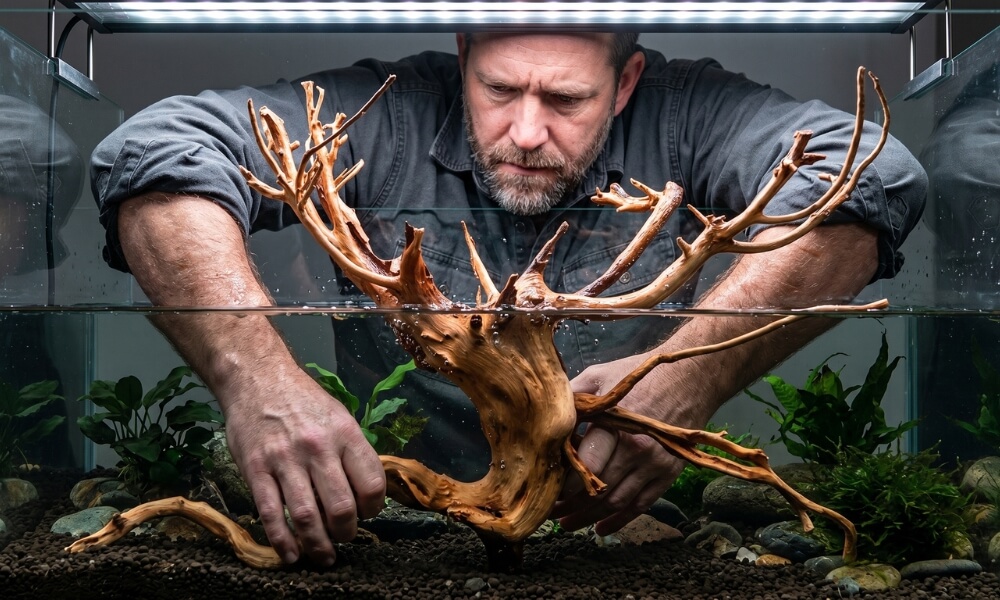
Attach driftwood to rock or slate for immediate stability
If the driftwood needs to go into the tank right away, attaching it to a heavy base is one of the best working solutions. A rock or slate base adds enough weight to keep the wood submerged while it continues soaking inside the aquarium. This is especially useful in aquascaping, where layout stability matters as much as appearance. It also reduces the chance of the piece lifting and ruining the hardscape.
- Immediate hold: The wood stays down even if it is still naturally buoyant.
- Hardscape stability: A fixed base keeps the layout from shifting after setup.
- Better aquascaping control: You can place the piece exactly where you want it and keep it there.
- Bridge solution: The base works while the wood finishes waterlogging naturally.
So if you need same-day stability, attaching driftwood to a heavy base is one of the most practical options.

Use aquarium-safe glue for a cleaner fixed setup
Glue is a good choice when you want the driftwood locked into place without relying on obvious weights. It works especially well when attaching wood to rock, slate, or another hardscape support piece. The important point is that the glue must be aquarium-safe, not just strong. A proper glue solution gives the layout a cleaner finish and reduces movement from the start.
- Cleaner appearance: The setup usually looks more natural than a loose weighting method.
- Strong bond: Proper aquarium-safe glue can hold wood and rock together securely.
- Good for permanent layouts: This is ideal for display tanks and long-term aquascapes.
- Safer than guessing: Using the right aquarium-safe product is much better than testing random household adhesives.
The conclusion here is clear: if you want a neat, stable hardscape, glue can be better than temporary tie-down methods.

Use temporary weight during the soaking stage
Temporary weighting is one of the easiest solutions when the wood is still being prepared outside the tank. You do not need to build a permanent support system just to soak driftwood. You only need enough weight to keep the piece fully submerged so the waterlogging process can continue properly. This is a low-cost, low-complication method that works well for large pieces.
- Simple to use: You do not need advanced tools or permanent hardware.
- Good for oversized pieces: Large wood that cannot be boiled often responds well to this method.
- Faster soaking: Full underwater exposure speeds up water absorption.
- Flexible prep option: You can remove the weight later once the wood is ready.
So for large driftwood, temporary weight is often the easiest practical prep solution before final installation.
How Long Does It Take for Driftwood to Sink?
There is no one-size-fits-all timeline for sinking driftwood. Some pieces may settle after a few days, while others may need weeks depending on shape, density, dryness, and size. This is why people get frustrated when they compare their driftwood to someone else’s result. The better way to judge progress is not by the calendar alone, but by how the wood behaves in water.
- Small pieces: These usually sink faster because there is less internal volume to waterlog.
- Large pieces: These usually need more time because they hold more air and take longer to saturate.
- Dense wood: This often becomes stable faster once it starts taking in water properly.
- Branch-heavy wood: This usually takes longer because the form traps more air and creates more buoyancy.
Common Mistakes When Trying to Sink Aquarium Driftwood
Most floating problems get worse because of bad prep choices, not because the driftwood is impossible to use. Hobbyists often rush, use the wrong materials, or skip basic preparation because they want the wood in the tank immediately. That usually creates more work later, not less. If you avoid a few common mistakes, the entire process becomes much easier.
- Rushing the setup: This leads to unstable hardscape and repeated adjustments.
- Using unsafe materials: Random adhesives or weights can create avoidable risk.
- Skipping prep: This usually makes the floating problem worse, not better.
- Ignoring wood type: Some shapes and densities require more patience than others.
Choosing Better Driftwood for Easier Setups
A better piece of driftwood makes the entire process easier. Good driftwood still needs prep, but cleaner selection, better structure, and more practical sizing reduce how much trouble you face later. This matters for hobbyists, but it also matters for retailers and wholesale buyers. If the wood is easier to prepare, the end-user experience is better from the start.
- Solid structure: Stable wood is easier to prep and easier to trust in the tank.
- Cleaner surface: Less loose bark and loose debris means less cleanup and less frustration.
- Practical size: Wood that matches the intended tank size is easier to soak, boil, or anchor.
- Workable shape: A piece that can be placed and secured easily creates a better setup experience.
The practical takeaway is that better sourcing reduces downstream prep problems.
Why Thanh Tung Thinh Can Be a Practical Sourcing Option for Bulk Driftwood Buyers
If you want driftwood that is easier for buyers to prepare and use, sourcing matters. Thanh Tung Thinh can be a practical option for businesses looking for bulk driftwood supply from Vietnam with more consistent sizing, cleaner selection, and wholesale support.
- Bulk supply: Suitable for importers, retailers, and wholesale buyers.
- Better consistency: More uniform pieces are easier to sink and position.
- Vietnam sourcing: Direct supplier communication can improve sourcing efficiency.

 WhatsApp: +84 96 394 91 78
 Email: [email protected]
 Website: https://vietaquaticwoods.com/
 Pinterest: https://www.pinterest.com/vietaquaticwoods/
Better-sorted driftwood improves end-user experience
If the driftwood is cleaner, more consistent, and better sorted, buyers spend less time fighting setup problems. That matters whether the customer is a hobbyist buying one piece or a retailer selling many pieces. Easier prep means better first impressions, fewer complaints, and more predictable product performance. In a competitive market, that matters.
- Less setup frustration: Buyers can get results faster with fewer mistakes.
- More predictable prep time: Cleaner wood gives a more consistent experience.
- Better customer satisfaction: Easier-to-use products reduce complaints.
- Stronger resale value: Better quality supports better product positioning.
So for sellers and buyers alike, driftwood quality is not just about appearance. It is also about usability.
Final Answer
The direct answer to how to sink driftwood aquarium is this: soak the wood first, boil it if the piece is small enough, and anchor it if you need immediate stability. Do not look for one trick that works for every size and shape. Match the method to the wood, and let the piece become stable instead of trying to force it too early. That approach gives you the best balance of speed, safety, and control.
- Best all-around method: Long soaking gives the safest and most stable result.
- Fastest method for small pieces: Boiling speeds up water absorption and trapped-air release.
- Best immediate-use option: Attach the wood to a heavy base or stable support.
- Best long-term mindset: Let the driftwood become naturally stable instead of fighting the process.
The conclusion is simple: floating driftwood is normal, but it becomes easy to manage once you use the right prep method for the piece you have.
FAQ
How do I make driftwood sink faster in an aquarium?
The fastest way is to boil small pieces and soak larger ones while keeping them fully submerged. If the driftwood still needs to go into the tank right away, anchor it to a heavy rock or base so it stays down while it continues absorbing water. This gives you both speed and control. It also reduces the chance of the layout shifting later.
Why is my driftwood still floating after soaking?
The most likely reason is that the wood still contains trapped air and has not become fully waterlogged yet. Large pieces, branch-heavy pieces, and very dry wood often need more time than people expect. If only part of the wood was underwater during soaking, that can also slow the process. The fix is usually more soaking, better submersion, or added weight during prep.
How long does it take for aquarium driftwood to sink?
There is no exact timeline because it depends on the size, density, and shape of the driftwood. Small pieces can become stable much faster, while large or complex pieces may take significantly longer. The best sign is not the number of days. The best sign is whether the wood sinks and stays down on its own.
Can I glue driftwood to a rock?
Yes, that is one of the most practical ways to keep driftwood submerged in a finished layout. The glue must be aquarium-safe, and the rock or base should be stable enough to hold the wood down. This method works especially well for aquascapes where you want a clean, fixed result. It is often better than using a loose weight inside the display tank.
Does boiling driftwood make it sink faster?
Yes, boiling usually helps small pieces sink faster because it drives out trapped air and speeds up water absorption. It can also help release some tannins before the wood goes into the aquarium. This makes the driftwood easier to manage overall. The limitation is that large pieces are often too big to boil safely.
Is it safe to use weights on driftwood?
Yes, as long as the weight is clean, stable, and safe for aquarium use. Temporary weighting is especially useful during the soaking stage because it keeps the entire piece underwater. That helps the wood waterlog more evenly. In the display tank, a rock or fixed base usually looks better than a random loose weight.
What type of driftwood sinks the easiest?
Dense, compact driftwood usually sinks more easily than branch-heavy or decorative bonsai-style pieces. Larger internal air spaces and more complex shapes usually create more buoyancy. That does not mean light or branchy driftwood is bad. It just means it usually needs more prep, more patience, or better anchoring.
